

Prof. Licheng Sun’s group in the Center of Artificial Photosynthesis for Solar Fuels at Westlake University recently published a research paper in the Angewandte Chemie International Edition. The paper is titled “Poly (Dibenzothiophene-Terphenyl Piperidinium) for High Performance Anion Exchange Membrane Water Electrolysis.”
The research started from the OH− conduction mechanisms, developing a high performance anion exchange membrane for water electrolysis through enhancing the Grotthuss mechanism (Fig. 1a). The Grotthuss mechanism, transports OH− ions through the formation and cleavage of the hydrogen–oxygen bond. When a large and strong hydrogen bond network exists, OH− ions can be transported swiftly from one side to another side. As a result, the original OH− ion became H2O molecular at one side of the network, and the original H2O molecular on the other side of the network became the newly formed OH− ion.
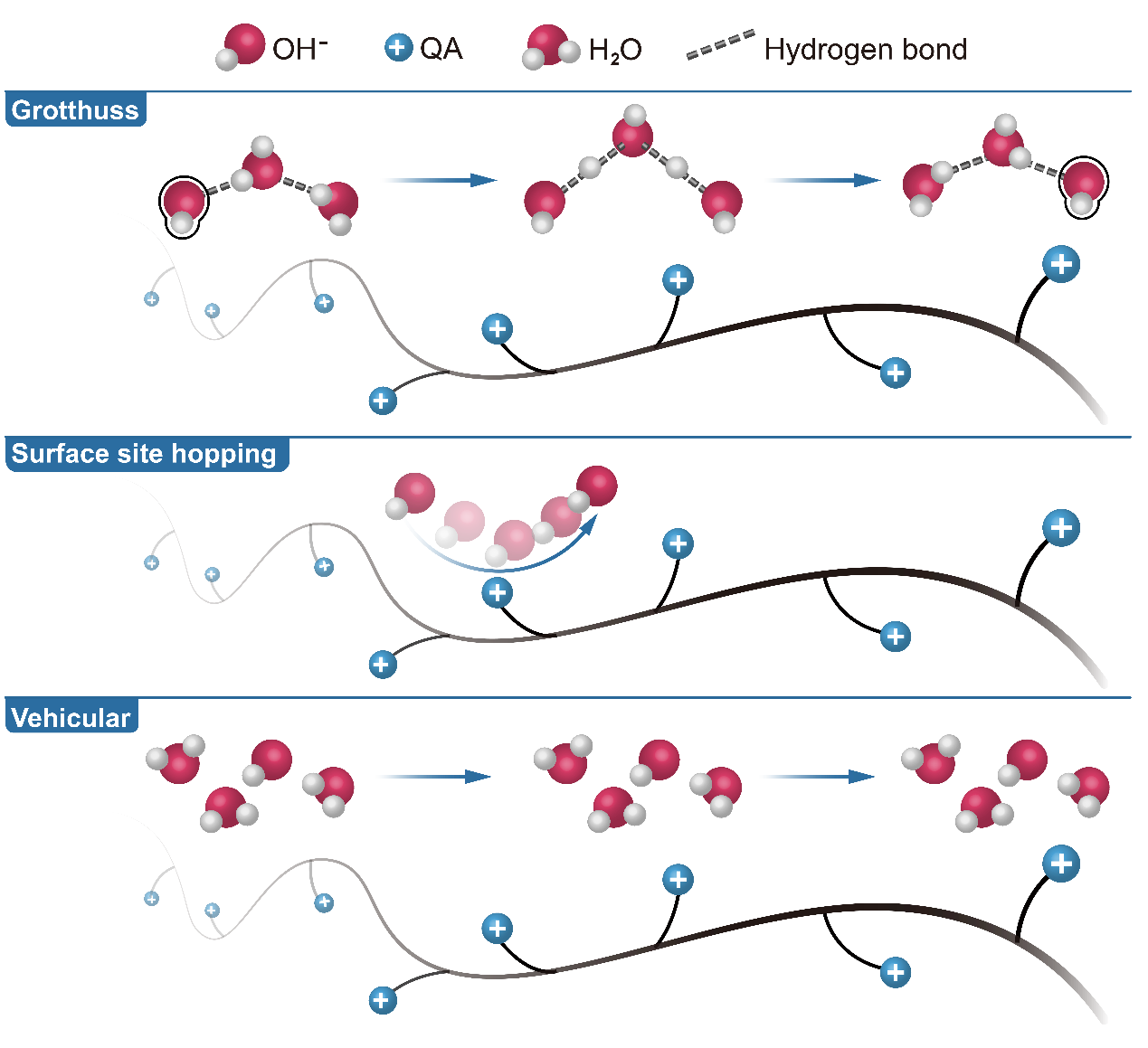
Fig. 1 OH− conducting mechanism. a) The Grotthuss mechanism. b) The surface site hopping mechanism. c) The vehicular mechanism. QA denotes quaternary ammonium salt.
To efficiently utilize the Grotthuss mechanism, the research group introducing the dibenzothiophene into the polymer structure. The S atom of the dibenzothiophene facilitates the formation of a well-developed hydrogen bond network, bridging adjacent piperidinium-induced surface site hopping regions and generating the continuous OH− conducting highway (Fig. 2). Z−S-20 demonstrated an impressive OH− conductivity of 182±28 mS/cm at 80 °C, surpassing that of PAP-TP-100 by 69 %. Utilizing Z−S-20 in a PGM-free AEM-WE (anion exchange membrane water electrolysis) device resulted in a remarkable current density of 7.12 A/cm2 at 2.0 V, 80 °C. Furthermore, Z−S-20 exhibited good durability, as evidenced by its stable performance after 650 h operation at 40 °C, 2 A/cm2. The bridging strategy for ion-conducting highway construction described in this work holds universal applicability in various ion exchange membrane designs. It promises to offer significant advantages to anion exchange membranes, proton exchange membranes, and even bipolar membranes in future research.
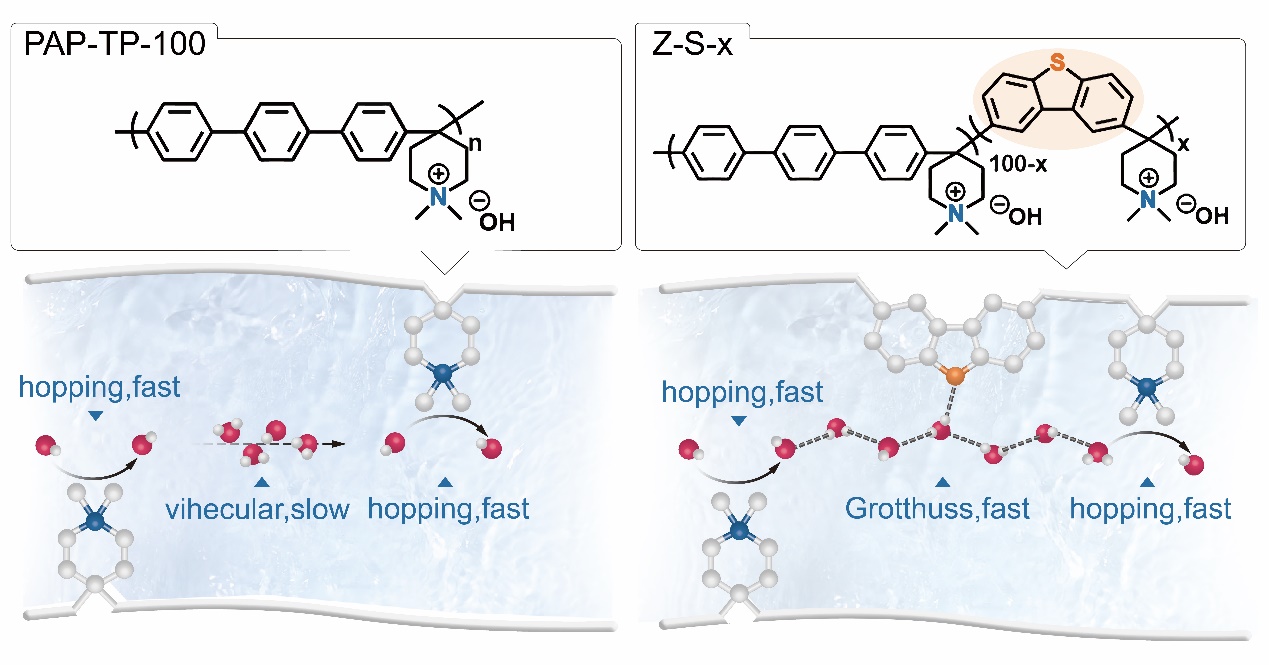
Fig. 2 Schematic illustration of the hydroxide conducting highway constructed through the bridging strategy.
Ph.D. student Wentao Zheng, Post doctor Lanlan He, associate research fellow Tang Tang are the co-first authors. Prof. Licheng Sun is the corresponding author.